Rajsamand · Rajasthan · advising since 2004
Marble Quarry and Processing Insurance in Rajsamand
A marble operation carries two quite different risks under one owner: a quarry, where the exposure is heavy plant and people, and a processing unit, where it is gang saws, polishing lines and a product that is easy to break and hard to value once broken.
Or request a callback. Free, no obligation, and we answer at any hour.
What to know
- The largest insurable asset on most quarry sites is mobile plant, and a standard fire policy on the premises does not follow an excavator or a wire saw around the pit.
- Injury exposure at the working face is the highest of any trade we handle in this belt, and liability under the Code on Social Security, 2020 does not depend on anyone being at fault.
- Dimensional stone in transit breaks rather than burns, and proving the pre-despatch condition of a slab is most of the argument in a transit claim.
- Haul roads, blasting and public access create a third-party exposure that most owners have never had sized.
Watch: quarry to site, in 60 seconds
Easy English with Hindi · खदान से साइट तक: जहाँ बीमा साथ छोड़ देता है
A 60-second film in easy English and Hindi on where marble and granite insurance stops, from the quarry face to the port: machines and contract labour at the quarry, gang saws in the factory, loading, the 7 events a basic transit policy pays for on the road, CIF at the port, and what to do if a slab arrives broken. Shot on real quarries, factories, trucks and ports. Watch it on its own page.
Read the film: every line, in English and Hindi
| 0:00 | Marble and granite. Quarry to site: where your insurance stops. 5 places stone gets damaged, and what to check at each.मार्बल और ग्रेनाइट। खदान से साइट तक: जहाँ बीमा साथ छोड़ देता है। 5 जगहें जहाँ पत्थर का नुकसान होता है, और हर जगह क्या जाँचना है। |
| 0:05 | The journey of a block, from the pit to the port: quarry, factory, loading, road, port.एक ब्लॉक का सफ़र, खदान से बंदरगाह तक: खदान, फ़ैक्टरी, लदान, सड़क, बंदरगाह। |
| 0:10 | 1. Quarry: machines and people. Machines in the pit need plant and machinery cover. Worker hurt: the owner is liable, even with no fault. Contract labour too, under section 81.1. खदान: मशीनें और लोग। खदान की मशीनों के लिए प्लांट एंड मशीनरी कवर। मज़दूर घायल: गलती न हो तब भी ज़िम्मेदारी मालिक की। ठेके के मज़दूर भी, धारा 81 के तहत। |
| 0:17 | 2. Factory: gang saws and polishing lines. Fire policy covers the premises. Machine breaks down: machinery breakdown cover. Lost business: not in a normal fire policy.2. फ़ैक्टरी: गैंग-सॉ और पॉलिशिंग लाइन। फायर पॉलिसी परिसर को कवर करती है। मशीन ख़राब: मशीनरी ब्रेकडाउन कवर। कारोबार का नुकसान: आम फायर पॉलिसी में नहीं। |
| 0:25 | 3. Loading: where most stone breaks. Poor packing by you: never covered. Take photos before the tirpal goes on. Crane loading: check when cover starts.3. लदान: जहाँ सबसे ज़्यादा पत्थर टूटता है। आपकी कमज़ोर पैकिंग: कभी कवर नहीं। तिरपाल डालने से पहले फ़ोटो लीजिए। क्रेन से लदान: देखिए कवर कब शुरू होता है। |
| 0:32 | 4. On the road: the basic policy pays for 7 events only. Overturning and collision: covered. Chipping and handling damage: not covered. Theft and short delivery: not covered. Poor packing by you: not covered. Rain is not one of them either. Check what your own policy says before the load leaves.4. सड़क पर: बेसिक पॉलिसी सिर्फ़ 7 घटनाओं का पैसा देती है। पलटी और टक्कर: कवर। टूट-फूट और लदान का नुकसान: कवर नहीं। चोरी और माल कम पहुँचना: कवर नहीं। आपकी कमज़ोर पैकिंग: कवर नहीं। बारिश भी इनमें नहीं। माल निकलने से पहले देखिए आपकी पॉलिसी क्या कहती है। |
| 0:40 | 5. Export: CIF gives the smallest sea cover. It pays only for major accidents such as fire, sinking or collision. Theft and most water damage are left out. The sales contract sets the sea cover. Check it.5. निर्यात: CIF में सबसे सीमित समुद्री कवर। यह सिर्फ़ आग, डूबने या टक्कर जैसे बड़े हादसों का पैसा देता है। चोरी और ज़्यादातर पानी का नुकसान बाहर। समुद्री कवर बिक्री अनुबंध तय करता है। जाँचिए। |
| 0:45 | Slab arrived broken? Do these 4 things. Take photos before moving anything. Get the damage written on the challan, signed by the driver. Keep the packing for the surveyor. Written notice to the transporter within 180 days of booking.स्लैब टूटकर पहुँचा? ये 4 काम कीजिए। कुछ भी हटाने से पहले फ़ोटो लीजिए। चालान पर नुकसान लिखवाइए, ड्राइवर के हस्ताक्षर के साथ। सर्वेयर के लिए पैकिंग वैसी ही रखिए। बुकिंग से 180 दिन में ट्रांसपोर्टर को लिखित नोटिस। |
| 0:52 | Free policy check. Send your policy on WhatsApp, 92514 56334. We tell you where your cover stops. Rakshit Financial Services, Udaipur, since 2004.मुफ़्त पॉलिसी जाँच। अपनी पॉलिसी व्हाट्सऐप कीजिए, 92514 56334, और जानिए बीमा कहाँ साथ छोड़ता है। रक्षित फाइनेंशियल सर्विसेज़, उदयपुर, 2004 से। |
Watch: 2 short videos on this topic
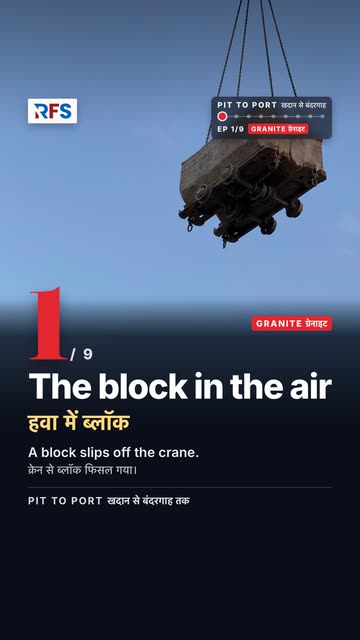
From Pit to Port, a video series in easy English and Hindi on marble, granite and marine cover. Under 30 seconds each.
Plant, and where the fire policy stops
A fire and special perils policy covers property at the insured premises. Mobile plant working across a pit, an excavator, a loader, a wire saw rig, a compressor, is not sitting at a fixed location in the way that policy contemplates, and owners regularly find the machine that mattered most was the one outside the schedule.
The instruments for this are contractors plant and machinery cover for the mobile fleet and a machinery breakdown policy for fixed plant. They price differently and respond differently, and which one a given asset belongs under is worth settling before a loss rather than during one.
Gang saws and polishing lines in the processing unit are the fixed side of that: high value, long lead times on parts, and a breakdown that stops the line rather than slowing it.
People at the working face
The Code on Social Security, 2020, which absorbed the Employees' Compensation Act on 21 November 2025, makes the employer liable for injury arising out of and in the course of employment whether or not anybody was negligent. On a quarry that is not a theoretical exposure, and the compensation is calculated from age and wages under the statutory table of factors rather than negotiated.
Contract labour is where this most often goes wrong. Under section 81 of the Code, where work that is part of the owner's own business is done through a contractor, the owner can be made to pay compensation to the contractor's injured worker and recover it from the contractor. A policy that names only direct employees can leave the largest part of the workforce outside it.
A group personal accident policy sits alongside rather than instead of this. It pays a benefit regardless of fault or employment status, which is frequently what an owner actually wants to be able to offer a family.
Third parties, blasting and haul roads
Quarrying generates public liability in ways ordinary manufacturing does not: vibration and flyrock from blasting, dust, and heavy vehicles on shared roads. The Public Liability Insurance Act imposes no-fault liability where hazardous substances are handled, and separately from that, a general public liability policy is what responds to a neighbour's damaged structure or an injured passer-by.
The limit is the decision that matters, and it is usually set too low because it is quoted as a small line on a package. It is worth sizing against a realistic worst case rather than against the premium.
Getting stone to the customer
Marble and granite move as heavy, fragile, high-value units, and the loss is almost always breakage rather than fire or theft. Packing, blocking and the way a slab is loaded decide both whether it arrives and whether a claim survives the surveyor.
A road carrier's liability under the Carriage by Road Act is capped against the freight rather than the value of the consignment, so the consignment note is not a substitute for cover.
Photographs at despatch are the cheapest thing an operator can do to protect a transit claim. Condition before loading is the fact a surveyor cannot reconstruct afterwards, and its absence is the most common reason a breakage claim is reduced.
Frequently asked questions
Do you have an office in Rajsamand?
No. Our office is in Udaipur at 784 Rani Road, about 65km away, and we advise operators across the Rajsamand and Nathdwara belt from there. Risk inspections and claims are done on site; the rest runs on WhatsApp, phone and email.
Is my excavator covered by the factory fire policy?
Usually not, and this is the single most common gap we find on quarry programmes. A fire and special perils policy covers property at the stated premises. Mobile plant moving around a pit generally needs contractors plant and machinery cover, and fixed processing plant needs machinery breakdown. Send us the schedule and we will tell you which of your assets are actually named.
We use contract labour. Who is liable if someone is injured?
Often the principal employer: under section 81 of the Code on Social Security, 2020, the owner can be made to pay compensation to a contractor's injured worker on its work, and recover it from the contractor. It is worth establishing before an accident, because a policy written for direct employees only can leave most of the people on site outside it.
A slab arrived broken and the transporter is refusing. What now?
Move quickly: photograph the consignment as received without unloading further, give the carrier written notice inside the time limit in the consignment note, and keep the packing exactly as it is. A carrier's liability is capped against the freight in any case, which is why a marine transit policy is what usually pays. Send us what you have and we will tell you what is still recoverable.
What does a broker cost?
Nothing to you. We are remunerated by the insurer when cover is placed, so reviews, comparisons across insurers and claims support carry no fee.
Related: Marble and granite quarrying insurance · The three-insurer comparison · Marble transit insurance · Plant and machinery insurance · Workmen compensation calculator · Workmen compensation for construction companies